
Menu

THE HOOK
A low slung sleek black car sweeps into the parking space alongside me as I’m reversing out of mine at Kirstenbosch after a walk. The music is playing at top volume. A captivating jazz guitar … melancholy, with emotional cadences, chord progressions flooded with yearning, heart-stopping. Inside the car, 2 stylish young men, caps on backwards, sunglasses, backpacks, engrossed in their conversation, maybe in their mid-30’s. Abruptly, the music stops as they get out of the car. I hesitate for a moment then pull back into my parking space, get out of my car and follow them, feeling like a weird sort of groupie. I’m a jazz fan and that single moment of music is holding me hostage.
‘Hi!’ I call after them. They both turn. ‘ I love that piece of music you were just playing,’ I say. ‘Can you tell me the name of song, the artist?’
One of the men pulls out his phone and consults it.
‘Sure, ‘ he smiles.’ It’s a band called Hotel Mellowtone. The song is ‘Half-packed Suitcase.’
I thank him and swoon a little more as I return to my car. The images the evocative title bring up, the heartbreak already drenching the melody line. I can’t wait to get home and to listen to the whole thing, expand on the enticing snippet I’d heard.
I find it easily enough play it through and much as I want to love it… I’m strangely disappointed. Somehow, it doesn’t live up to the promise of the haunting string of notes that captivated me in the car park. There’s something missing and I can’t put my finger on it. I listen to it again. I research the band.
Half Packed Suitcase ℗ 2025 Fifth Bar Records Released on: 2025-07-11 Programmer: Silas Monroe Producer: Hotel Mellowtone Composer: Silas Monroe. There’s no bio, no interviews, no behind the scenes content. Nothing. A blank. I have to draw the inevitable conclusion - and ‘programmer’ is the clue - it’s been AI generated. There is no band.
There is no band. I feel duped. I become obsessed with figuring out my disappointment.
UNTANGLING THE BAIT
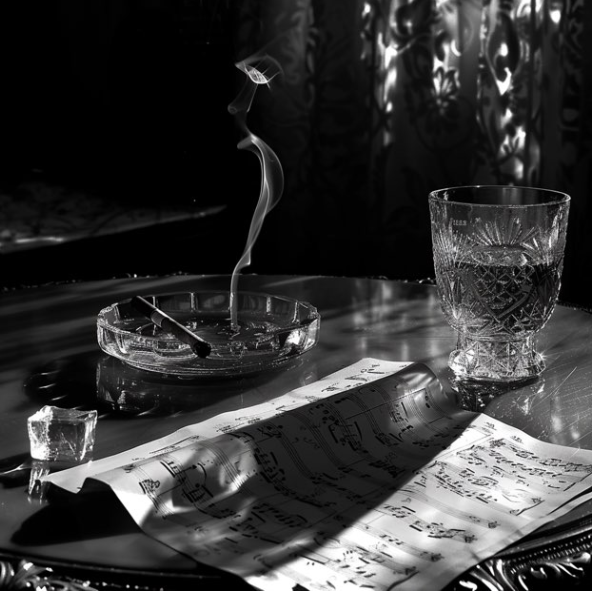
Bit by bit, I pick the appeal of the piece apart. I know certain chords can conjure specific emotions in the listener and I notice how the melody line and chord progressions evoke a nostalgic mood, a bygone era. Even the black and white image that goes with the piece – the old-fashioned deco table, the sheet music (perhaps still in the middle of being composed) the half glass of whisky, a half-finished cigarette in an ashtray, the shadowy play of light through the curtain (and what’s with the ice cube that should be inside the glass?) – all speak of something unfinished, retrospective, the pleasurable melancholy of loss through incompleteness.
I’m flummoxed: I was moved by something that was made by a machine. How could I have been so fooled? (In retrospect, it’s no accident I was instantly attracted by a fragment – by its very nature unfinished. It’s a particular nuance I’m hard-wired to respond to. But that’s just a personal foible, maybe shared by others?)
A LESSON IN HOW BAIT IS MADE
I come across this Instagram post by musician Benedict Cork.
It’s about how he’d posted the first verse of a new song-in-the-making for his fans and without warning, someone had gone and used AI to add a second verse and turn it into a fully-fledged song by a fake performer called ‘Eduardo Aguiles’. Blatant theft and there’s not a thing he can do about it. The most annoying part? It is – in Benedict’s words – ‘really good, genius even’. Poor man. Much as he tried to make light of it, he was flummoxed too – I felt for him. In effect, he’d been robbed of the creative process in finishing his own song. Its early raw version converted into something that now is not only complete, it’s more accomplished, more perfect than he could ever have achieved himself. Perfectly formed, perfectly performed, bait.
And this is where we stumble and get fooled; we are so beglamoured by the perfection of AI generated material, the perfect pitch, the perfect rendering, we overlook where it originated. Art was never meant to be judged by its perfection.
And what of AI-generated music like Half-packed Suitcase? I’ve heard people who shrug and say they don’t care how it was made or where it came from, if they enjoy the music, so what?
THE BAIT CONCEALS THE TRAP
I’m going to argue that when it comes to music (and writing), using AI to make it is parasitic. Without consent or compensation, AI feeds off all the online collective creative energy, the music humans have produced, to synthesize a derivative second-hand facsimile which is then sold back to us for profit. And we’re buying it. Every time we stream AI music we’re buying it.
Not only that, every time we ask AI to create on our behalf, it weakens us; erodes our own creative skills, our abilities begin to atrophy until the best thing we’re any good at is giving prompts. AI slowly destroying its hosts. A classic definition of a parasite.
The performance of music, with all its individual quirks, dynamics and natural flaws is born of the intelligence of the human body and mind. It originates out of the dexterity and skill of human hands, the attunement of breath and voice, from instruments made of real substances - wood, brass, reeds, strings, skins. I think about the hours and hours I’ve spent practicing a new song on the guitar, working out the chords, learning to sing the melody right. The hours rehearsing with the band. However effortless it may appear when we perform, there’s an invisible expense that like any parasite, AI never pays: a lived experience of time, energy and physical skill-building effort. It’s what gives performance its most human yet ineffable quality – genuine emotional resonance, felt by an attentive audience.
What was missing when I listened to Half-packed Suitcase was resonance. Feeling duped was the right response to the dissonance between the tantalising promise and what was delivered. So, what intention lies behind music produced by AI? I believe it’s to create an artifact so beguiling it disconnects us from valuing what is human-crafted over what is machine-made, from valuing too, having the discernment to tell the difference. That way, some unidentifiable persons - who were never originators - will profit with ease, without effort or risk, simply because as consumers, we no longer care where music actually comes from.
We’ll take the bait, oblivious to what is being lost and what we’re paying.
PS: While I was writing this piece, I wanted to listen again to Half-packed Suitcase, to remind myself once more how my ears deceived me, but it’s gone, vanished off the internet, leaving only traces of its title. It feels odd to be writing about something that has disappeared. It makes me wonder what the substance of its existence was, given where it came from: did it ever truly exist in the first place?
AI statement: I do not use AI in my writing; not to develop ideas or in any way shape how and what I write. Nor do I ‘run my writing by AI’ to proof-read or check for errors. This piece took me many hours of writing and re-writing over a period of 4-5 months. In this piece, I used Alter-AI to research the image for origin and copyright, similarly, I used it to research and confirm the machine-generated origins of the music-piece ‘Half-packed Suitcase’ (now no longer available on the internet as far as I can tell).
For me personally, AI works well for data analysis, running repetitive tasks and providing inside-understanding of how AI functions in the digital world. I deliberately do not say ‘please’ or ‘thank you’ when using AI, nor do I give it a gender as I don’t want to forget I am dealing with a machine masquerading as human-like; there is no ‘relationship’ inherent in our interaction. I also want to keep remembering that while AI itself is not human, it originated from and was constructed by humans. ‘What is the intention behind AI constructs?’ is the question we should always be asking ourselves. No, it’s really not always to make our lives easier or better.